Smart Speakers (Echo, Hub, that sort of thing)
The “Spy” in Your Living Room: Is Your Smart Speaker Actually Out to Get You?
1. The New Roommate Nobody Asked For
Picture this: You’re in the middle of making a batch of chocolate chip cookies. Your hands are caked in flour, the oven is preheated, and you realize you forgot to set a timer. Instead of wiping your hands and fumbling with your phone, you just yell at a little plastic cylinder on the counter: “Hey, set a timer for ten minutes!”
And it does it. Just like magic.
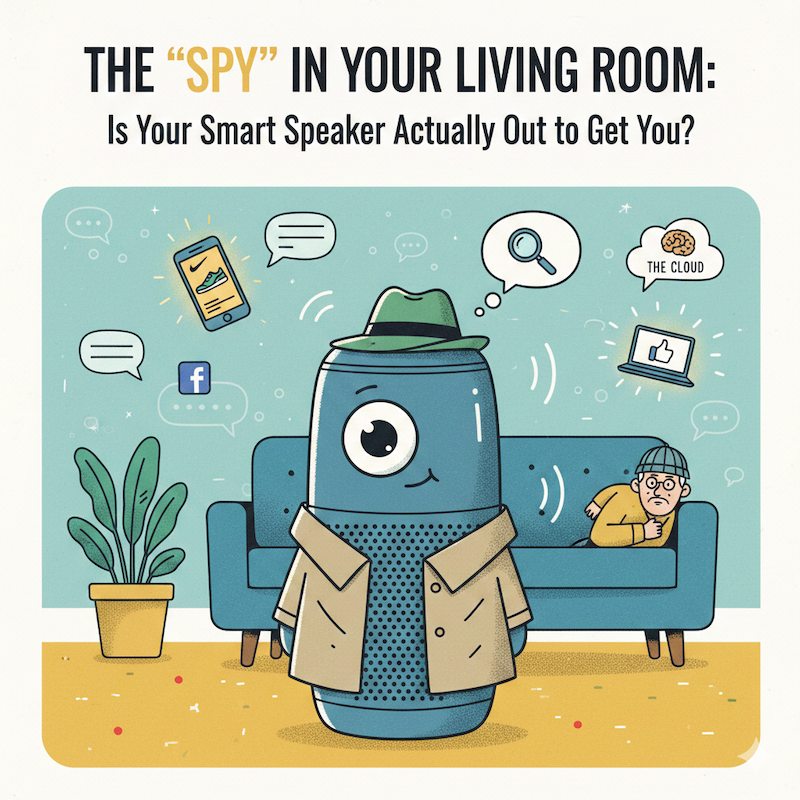
It’s pretty cool, right? But then, ten minutes later, you’re sitting on the couch talking to your spouse about how you really need new running shoes, and suddenly, an ad for Nikes pops up on your Facebook feed. That’s when the “creep factor” kicks in. We all have that one uncle at Thanksgiving who swears Alexa is a CIA operative, and honestly, sometimes it feels like he might be onto something. Is it always listening? Is it a spy? Or is it just a really helpful, slightly nosy roommate?
2. How It Works (Without the Boring Tech Jargon)
To understand if these things are spying on us, we have to understand how they “hear.” Think of your smart speaker like a waitress in a busy, loud diner. She’s standing near your table, but she isn’t actually listening to your private conversation about your boss. She’s just waiting to hear one specific word: “Waitress!”
Until she hears that “wake word,” she’s in Passive Mode. She has a tiny “buffer”—kind of like a two-second memory that constantly deletes itself. If she doesn’t hear her name, the information goes in one ear and out the other immediately.
Once you say the magic word, she switches to Active Mode. She “wakes up,” packs your request into a digital suitcase, and flings it across the country into “The Cloud.” That’s where the giant “brains” (huge server farms) translate your mumbled request into something the computer can understand. It’s a process called Natural Language Processing, but you can just think of it as a very fast translator who lives in the sky.
3. A Trip Down Memory Lane (It Started with a Shoebox)
This feels like futuristic sci-fi, but voice tech has been around longer than the internet. Way back in 1961, IBM showed off a machine called the “Shoebox.” It was literally the size of a shoebox and could recognize 16 words and the numbers 0 through 9. It wasn’t exactly ChatGPT, but it was the great-great-grandfather of what we have now.
Fast forward to 2011, and Apple put Siri on the iPhone. Suddenly, we were all talking to our phones in public like secret agents. Then, in 2014, Amazon dropped the Echo. That was the game-changer. Suddenly, everyone wanted a “smart home,” even if they only used the thing to check the weather or play “Baby Shark” for the kids.
4. The Elephant in the Room: Privacy & The “Spying” Scares
So, is it “always listening”? Technically, yes, but only for its name. However, there’s a big difference between listening for a keyword and recording your secrets.
The problem is the “Whoops” moments. We’ve all had it happen: you’re watching a movie, a character says something that sounds like “Alexa” or “Hey Google,” and the light on the speaker turns blue. Suddenly, your private conversation is being recorded and sent to the cloud because the speaker got confused.
The real “yikes” moment came in 2019 when we found out that companies like Amazon and Google actually had humans—real people with headphones—listening to some of those recordings. They said they were doing it to “train” the AI to understand accents better, but it still felt like finding out that the waitress at the diner was actually taking notes on your gossip to help the chef improve the menu. And let’s not forget: these recordings are digital footprints. In some cases, police have even used smart speaker data as “witnesses” in criminal investigations.
5. Is It Just a Salesman in a Box?
You might notice you don’t usually hear commercials on your smart speaker, but that doesn’t mean it isn’t selling you something. These companies aren’t giving you this tech out of the goodness of their hearts; they want you in their “ecosystem.”
It’s like a “lock-in” strategy. If it’s incredibly easy to say, “Buy more toilet paper,” and have it show up at your door the next day, you’re probably going to buy it from the company that made the speaker. They are also harvesting “contextual data.” They know when you wake up, what kind of music you like when you’re sad, and whether you have kids. They use that info to get to know you better than your own roommates do, all so they can show you the right ads on your other devices.
6. The Future: It’s Getting Weird (In a Cool Way)
The speakers we have now are basically just fancy remote controls, but they’re about to get a whole lot smarter. Thanks to things like ChatGPT, soon you won’t just be asking for the weather; you’ll be having actual conversations with your house.
There’s also some good news for the privacy-conscious. Tech companies are working on “Edge Processing.” This is just a fancy way of saying the speaker will get smart enough to do the “thinking” right there in your living room without sending your voice to the cloud at all.
Finally, we’re moving toward “Ambient Intelligence.” This is the idea that the house just knows what you want. Instead of you shouting for the lights to turn on, the house will sense you’ve walked into the room and adjust the temperature and lighting based on your mood. It’s a fine line between a five-star hotel and a haunted house.
7. Conclusion: To Plug or Unplug?
At the end of the day, it all boils down to a trade-off: How much of your privacy are you willing to give up for the sake of convenience?
You aren’t crazy for being a little skeptical—history shows that these companies haven’t always been 100% upfront. But you also aren’t a tinfoil-hat wearer for loving the fact that you can turn off the hallway light from your bed. Just use some common sense. Maybe don’t discuss your secret world-domination plans (or your social security number) right next to the device.
What about you? What’s the weirdest thing your smart speaker has ever accidentally recorded or said to you out of the blue? Let me know in the comments!